
Stop Being the Bottleneck of Your Company
This is how your physical debt is quietly killing your startup's performance.

April 17th, 2026
Stop Being the Bottleneck of Your Company
This is how your physical debt is quietly killing your startup's performance.
April 17th, 2026
Stop Being the Bottleneck of Your Company
This is how your physical debt is quietly killing your startup's performance.
Fernando Olivares
Dot Fer | ProductFitCoach
April 17th, 2026
Stop Being the Bottleneck of Your Company
This is how your physical debt is quietly killing your startup's performance.
April 17th, 2026
Stop Being the Bottleneck of Your Company
This is how your physical debt is quietly killing your startup's performance.
Fernando Olivares
Dot Fer | ProductFitCoach
April 17th, 2026
There's a mistake I see high performers make over and over again: they forget about their health, and still expect to perform at the top of their game. I get it. Especially in tech, where you're often all alone, expected to deliver what a whole team could have built four years ago, now with some form of AI strapped to your side. The pressure is real.
There's a mistake I see high performers make over and over again: they forget about their health, and still expect to perform at the top of their game. I get it. Especially in tech, where you're often all alone, expected to deliver what a whole team could have built four years ago, now with some form of AI strapped to your side. The pressure is real.
There's a mistake I see high performers make over and over again: they forget about their health, and still expect to perform at the top of their game. I get it. Especially in tech, where you're often all alone, expected to deliver what a whole team could have built four years ago, now with some form of AI strapped to your side. The pressure is real.
There's a mistake I see high performers make over and over again: they forget about their health, and still expect to perform at the top of their game. I get it. Especially in tech, where you're often all alone, expected to deliver what a whole team could have built four years ago, now with some form of AI strapped to your side. The pressure is real.

Photo by nikko macaspac on Unsplash.
Photo by nikko macaspac on Unsplash.
Photo by nikko macaspac on Unsplash.
Photo by nikko macaspac on Unsplash.
Photo by nikko macaspac on Unsplash.
But let's be honest for a second. Whenever something breaks in your product, you go fix it. Whenever a bug shows up, it goes on a list — and eventually gets resolved. You treat technical debt seriously because you know what happens when you don't. So here's a question worth sitting with:
But let's be honest for a second. Whenever something breaks in your product, you go fix it. Whenever a bug shows up, it goes on a list — and eventually gets resolved. You treat technical debt seriously because you know what happens when you don't. So here's a question worth sitting with:
But let's be honest for a second. Whenever something breaks in your product, you go fix it. Whenever a bug shows up, it goes on a list — and eventually gets resolved. You treat technical debt seriously because you know what happens when you don't. So here's a question worth sitting with:
But let's be honest for a second. Whenever something breaks in your product, you go fix it. Whenever a bug shows up, it goes on a list — and eventually gets resolved. You treat technical debt seriously because you know what happens when you don't. So here's a question worth sitting with:
But let's be honest for a second. Whenever something breaks in your product, you go fix it. Whenever a bug shows up, it goes on a list — and eventually gets resolved. You treat technical debt seriously because you know what happens when you don't. So here's a question worth sitting with:
What in the f*cking world is stopping you from treating yourself the same way?
That late night you pushed through, the workout you skipped, the "I'll eat whatever" mentality that's become your default — none of that is neutral. It's not just slowing you down. It's giving you physical debt. And like any debt, the interest rates are uncomfortable, and they compound.
That late night you pushed through, the workout you skipped, the "I'll eat whatever" mentality that's become your default — none of that is neutral. It's not just slowing you down. It's giving you physical debt. And like any debt, the interest rates are uncomfortable, and they compound.
That late night you pushed through, the workout you skipped, the "I'll eat whatever" mentality that's become your default — none of that is neutral. It's not just slowing you down. It's giving you physical debt. And like any debt, the interest rates are uncomfortable, and they compound.
That late night you pushed through, the workout you skipped, the "I'll eat whatever" mentality that's become your default — none of that is neutral. It's not just slowing you down. It's giving you physical debt. And like any debt, the interest rates are uncomfortable, and they compound.
That late night you pushed through, the workout you skipped, the "I'll eat whatever" mentality that's become your default — none of that is neutral. It's not just slowing you down. It's giving you physical debt. And like any debt, the interest rates are uncomfortable, and they compound.
The Performance Curve Nobody Talks About
Most people expect a straightforward relationship between time and performance: you put in the work, you get the results, things improve linearly. Reasonable expectation. The right one to aim for. In other words, something like this:
The Performance Curve Nobody Talks About
Most people expect a straightforward relationship between time and performance: you put in the work, you get the results, things improve linearly. Reasonable expectation. The right one to aim for. In other words, something like this:
The Performance Curve Nobody Talks About
Most people expect a straightforward relationship between time and performance: you put in the work, you get the results, things improve linearly. Reasonable expectation. The right one to aim for. In other words, something like this:
The Performance Curve Nobody Talks About
Most people expect a straightforward relationship between time and performance: you put in the work, you get the results, things improve linearly. Reasonable expectation. The right one to aim for. In other words, something like this:
The Performance Curve Nobody Talks About
Most people expect a straightforward relationship between time and performance: you put in the work, you get the results, things improve linearly. Reasonable expectation. The right one to aim for. In other words, something like this:
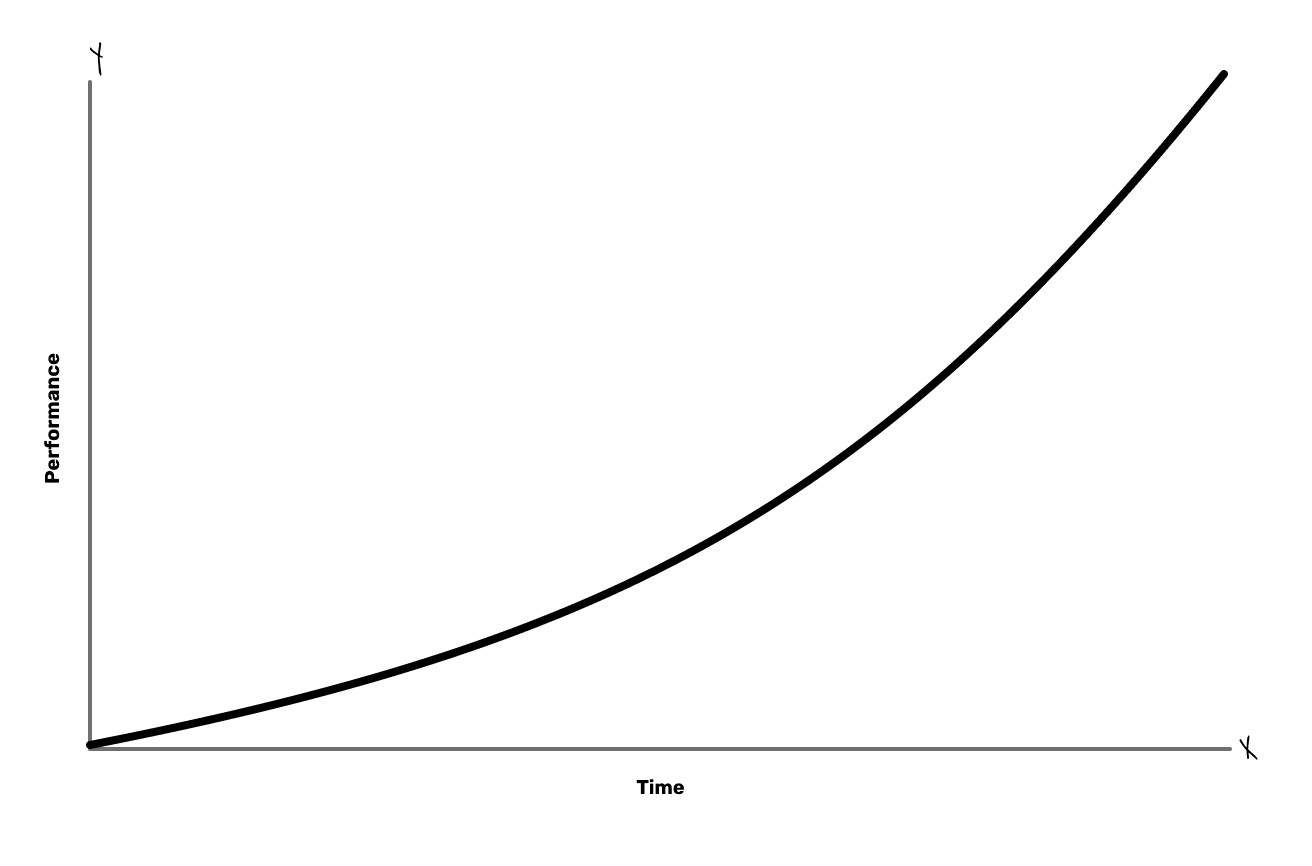
Where X would be time and Y your performance, so performance over time. But that's not how it tends to play out in practice. There are two other variables that almost nobody talks about:
Where X would be time and Y your performance, so performance over time. But that's not how it tends to play out in practice. There are two other variables that almost nobody talks about:
Where X would be time and Y your performance, so performance over time. But that's not how it tends to play out in practice. There are two other variables that almost nobody talks about:
Where X would be time and Y your performance, so performance over time. But that's not how it tends to play out in practice. There are two other variables that almost nobody talks about:
Where X would be time and Y your performance, so performance over time. But that's not how it tends to play out in practice. There are two other variables that almost nobody talks about:
Delivery Capacity & Physical Debt.
And they're deeply correlated.
And they're deeply correlated.
And they're deeply correlated.
And they're deeply correlated.
And they're deeply correlated.
Scientific study
A study published in the Journal of Occupational and Environmental Medicine analyzed over 2,200 employees from a large national employer, measuring the relationship between health risk factors and work productivity. The finding was straightforward: the higher the health risk factors, the greater the productivity loss. In plain terms — your physical debt is making you less productive. Ref: Boles M, et al. The relationship between health risks and work productivity. Journal of Occupational and Environmental Medicine. 2004;46(7):737-745. doi:10.1097/01.jom.0000131830.45744.97.
Scientific study
A study published in the Journal of Occupational and Environmental Medicine analyzed over 2,200 employees from a large national employer, measuring the relationship between health risk factors and work productivity. The finding was straightforward: the higher the health risk factors, the greater the productivity loss. In plain terms — your physical debt is making you less productive. Ref: Boles M, et al. The relationship between health risks and work productivity. Journal of Occupational and Environmental Medicine. 2004;46(7):737-745. doi:10.1097/01.jom.0000131830.45744.97.
Scientific study
A study published in the Journal of Occupational and Environmental Medicine analyzed over 2,200 employees from a large national employer, measuring the relationship between health risk factors and work productivity. The finding was straightforward: the higher the health risk factors, the greater the productivity loss. In plain terms — your physical debt is making you less productive. Ref: Boles M, et al. The relationship between health risks and work productivity. Journal of Occupational and Environmental Medicine. 2004;46(7):737-745. doi:10.1097/01.jom.0000131830.45744.97.
Scientific study
A study published in the Journal of Occupational and Environmental Medicine analyzed over 2,200 employees from a large national employer, measuring the relationship between health risk factors and work productivity. The finding was straightforward: the higher the health risk factors, the greater the productivity loss. In plain terms — your physical debt is making you less productive. Ref: Boles M, et al. The relationship between health risks and work productivity. Journal of Occupational and Environmental Medicine. 2004;46(7):737-745. doi:10.1097/01.jom.0000131830.45744.97.
Scientific study
A study published in the Journal of Occupational and Environmental Medicine analyzed over 2,200 employees from a large national employer, measuring the relationship between health risk factors and work productivity. The finding was straightforward: the higher the health risk factors, the greater the productivity loss. In plain terms — your physical debt is making you less productive. Ref: Boles M, et al. The relationship between health risks and work productivity. Journal of Occupational and Environmental Medicine. 2004;46(7):737-745. doi:10.1097/01.jom.0000131830.45744.97.
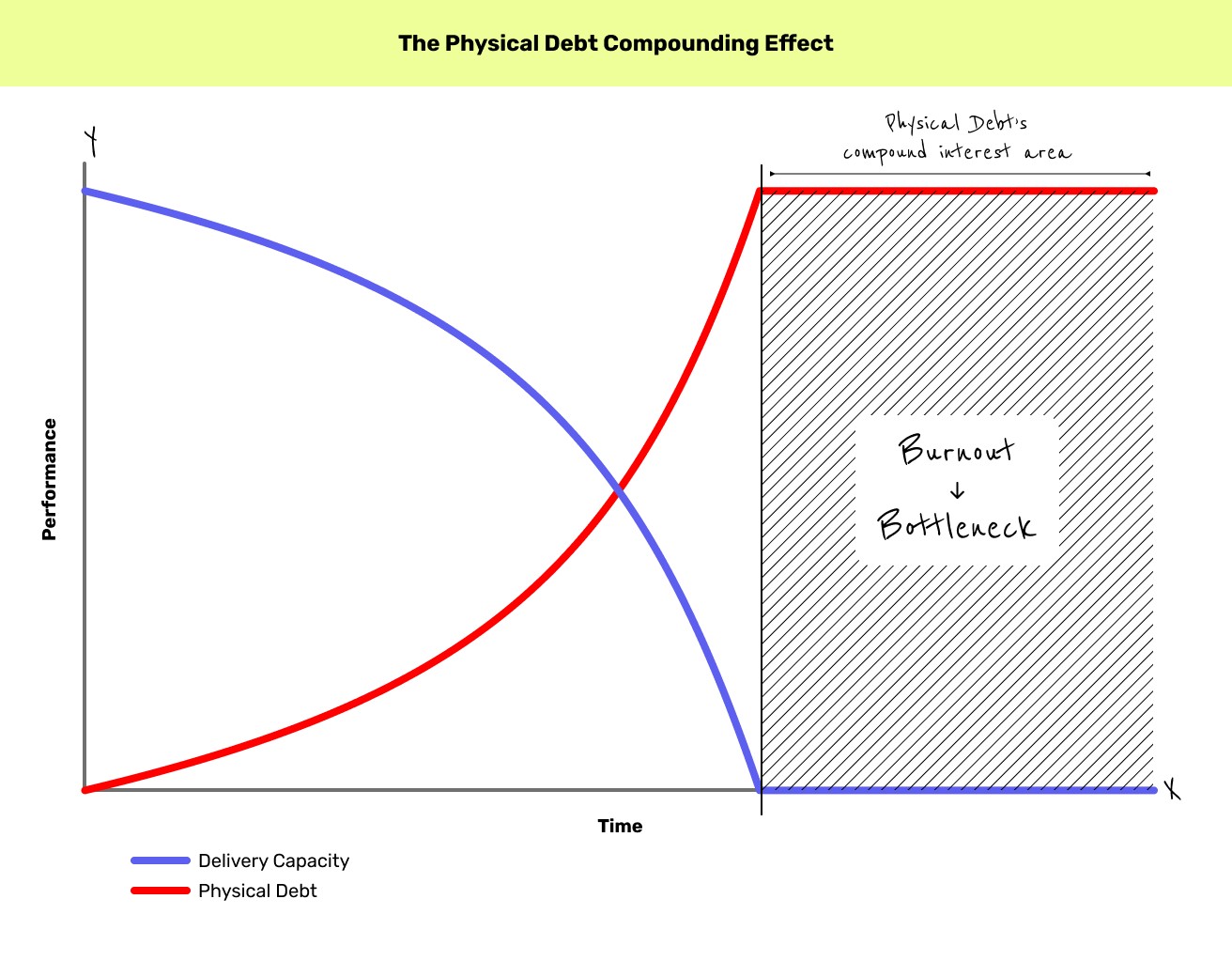
When physical debt accumulates, delivery capacity shrinks. What started as a high-performing individual quietly becomes someone who's burned out, hard to replace, and increasingly a bottleneck for the whole team. And the company ends up paying the compound interest on debt it never agreed to take on.
When physical debt accumulates, delivery capacity shrinks. What started as a high-performing individual quietly becomes someone who's burned out, hard to replace, and increasingly a bottleneck for the whole team. And the company ends up paying the compound interest on debt it never agreed to take on.
When physical debt accumulates, delivery capacity shrinks. What started as a high-performing individual quietly becomes someone who's burned out, hard to replace, and increasingly a bottleneck for the whole team. And the company ends up paying the compound interest on debt it never agreed to take on.
When physical debt accumulates, delivery capacity shrinks. What started as a high-performing individual quietly becomes someone who's burned out, hard to replace, and increasingly a bottleneck for the whole team. And the company ends up paying the compound interest on debt it never agreed to take on.
When physical debt accumulates, delivery capacity shrinks. What started as a high-performing individual quietly becomes someone who's burned out, hard to replace, and increasingly a bottleneck for the whole team. And the company ends up paying the compound interest on debt it never agreed to take on.
A Hot Fix: Three Pillars
The answer isn't going all-in on a dramatic wellness overhaul. It's about building a few sustainable systems around three core areas.
A Hot Fix: Three Pillars
The answer isn't going all-in on a dramatic wellness overhaul. It's about building a few sustainable systems around three core areas.
A Hot Fix: Three Pillars
The answer isn't going all-in on a dramatic wellness overhaul. It's about building a few sustainable systems around three core areas.
A Hot Fix: Three Pillars
The answer isn't going all-in on a dramatic wellness overhaul. It's about building a few sustainable systems around three core areas.
A Hot Fix: Three Pillars
The answer isn't going all-in on a dramatic wellness overhaul. It's about building a few sustainable systems around three core areas.
1. Sleep prioritization
Sleep is the single most powerful performance tool available to you — physical and cognitive. And the interesting thing about committing to better sleep is that it forces you to audit everything else: when you eat, how you wind down, what you do in the evenings. Getting sleep right creates a domino effect that starts pulling other habits into place. One good night of sleep will do more for your output than any extra hours you could squeeze into the day.
1. Sleep prioritization
Sleep is the single most powerful performance tool available to you — physical and cognitive. And the interesting thing about committing to better sleep is that it forces you to audit everything else: when you eat, how you wind down, what you do in the evenings. Getting sleep right creates a domino effect that starts pulling other habits into place. One good night of sleep will do more for your output than any extra hours you could squeeze into the day.
1. Sleep prioritization
Sleep is the single most powerful performance tool available to you — physical and cognitive. And the interesting thing about committing to better sleep is that it forces you to audit everything else: when you eat, how you wind down, what you do in the evenings. Getting sleep right creates a domino effect that starts pulling other habits into place. One good night of sleep will do more for your output than any extra hours you could squeeze into the day.
1. Sleep prioritization
Sleep is the single most powerful performance tool available to you — physical and cognitive. And the interesting thing about committing to better sleep is that it forces you to audit everything else: when you eat, how you wind down, what you do in the evenings. Getting sleep right creates a domino effect that starts pulling other habits into place. One good night of sleep will do more for your output than any extra hours you could squeeze into the day.
1. Sleep prioritization
Sleep is the single most powerful performance tool available to you — physical and cognitive. And the interesting thing about committing to better sleep is that it forces you to audit everything else: when you eat, how you wind down, what you do in the evenings. Getting sleep right creates a domino effect that starts pulling other habits into place. One good night of sleep will do more for your output than any extra hours you could squeeze into the day.
2. Schedule clearance
Be protective of your time. Try treating your calendar as a productivity compass — if it's not on the calendar, maybe it shouldn't be happening. This isn't about rigidity, it's about intention. Give it a few consistent weeks and you'll likely surprise yourself with what you actually accomplish.
2. Schedule clearance
Be protective of your time. Try treating your calendar as a productivity compass — if it's not on the calendar, maybe it shouldn't be happening. This isn't about rigidity, it's about intention. Give it a few consistent weeks and you'll likely surprise yourself with what you actually accomplish.
2. Schedule clearance
Be protective of your time. Try treating your calendar as a productivity compass — if it's not on the calendar, maybe it shouldn't be happening. This isn't about rigidity, it's about intention. Give it a few consistent weeks and you'll likely surprise yourself with what you actually accomplish.
2. Schedule clearance
Be protective of your time. Try treating your calendar as a productivity compass — if it's not on the calendar, maybe it shouldn't be happening. This isn't about rigidity, it's about intention. Give it a few consistent weeks and you'll likely surprise yourself with what you actually accomplish.
2. Schedule clearance
Be protective of your time. Try treating your calendar as a productivity compass — if it's not on the calendar, maybe it shouldn't be happening. This isn't about rigidity, it's about intention. Give it a few consistent weeks and you'll likely surprise yourself with what you actually accomplish.

Stop skipping your workouts with FitDots
FitDots generates Time-Flexible, no equipment workouts that adapt to your schedule.
Stop skipping your workouts with FitDots
FitDots generates Time-Flexible, no equipment workouts that adapt to your schedule.
Stop skipping your workouts with FitDots
FitDots generates Time-Flexible, no equipment workouts that adapt to your schedule.
Stop skipping your workouts with FitDots
FitDots generates Time-Flexible, no equipment workouts that adapt to your schedule.
Stop skipping your workouts with FitDots
FitDots generates Time-Flexible, no equipment workouts that adapt to your schedule.
3. Physical activity
The science here is clear and consistent: exercise is a cognitive performance booster. As a baseline, aim for 7,000 steps a day and at least three sessions of strength training per week. It doesn't need to be complicated. It just needs to happen.
3. Physical activity
The science here is clear and consistent: exercise is a cognitive performance booster. As a baseline, aim for 7,000 steps a day and at least three sessions of strength training per week. It doesn't need to be complicated. It just needs to happen.
3. Physical activity
The science here is clear and consistent: exercise is a cognitive performance booster. As a baseline, aim for 7,000 steps a day and at least three sessions of strength training per week. It doesn't need to be complicated. It just needs to happen.
3. Physical activity
The science here is clear and consistent: exercise is a cognitive performance booster. As a baseline, aim for 7,000 steps a day and at least three sessions of strength training per week. It doesn't need to be complicated. It just needs to happen.
3. Physical activity
The science here is clear and consistent: exercise is a cognitive performance booster. As a baseline, aim for 7,000 steps a day and at least three sessions of strength training per week. It doesn't need to be complicated. It just needs to happen.
Scientific study
A research published by the National Institutes of Health and the National Institute on Aging (NIA) highlights that exercise is a primary driver of brain plasticity. It demonstrates that physical activity enhances the molecular machinery responsible for learning and memory. In other words, your brain works better with training. Ref: Van Praag H. Exercise and the brain: something to chew on. Trends in Neurosciences. 2009;32(5):283-290. doi:10.1016/j.tins.2008.12.007.
Scientific study
A research published by the National Institutes of Health and the National Institute on Aging (NIA) highlights that exercise is a primary driver of brain plasticity. It demonstrates that physical activity enhances the molecular machinery responsible for learning and memory. In other words, your brain works better with training. Ref: Van Praag H. Exercise and the brain: something to chew on. Trends in Neurosciences. 2009;32(5):283-290. doi:10.1016/j.tins.2008.12.007.
Scientific study
A research published by the National Institutes of Health and the National Institute on Aging (NIA) highlights that exercise is a primary driver of brain plasticity. It demonstrates that physical activity enhances the molecular machinery responsible for learning and memory. In other words, your brain works better with training. Ref: Van Praag H. Exercise and the brain: something to chew on. Trends in Neurosciences. 2009;32(5):283-290. doi:10.1016/j.tins.2008.12.007.
Scientific study
A research published by the National Institutes of Health and the National Institute on Aging (NIA) highlights that exercise is a primary driver of brain plasticity. It demonstrates that physical activity enhances the molecular machinery responsible for learning and memory. In other words, your brain works better with training. Ref: Van Praag H. Exercise and the brain: something to chew on. Trends in Neurosciences. 2009;32(5):283-290. doi:10.1016/j.tins.2008.12.007.
Scientific study
A research published by the National Institutes of Health and the National Institute on Aging (NIA) highlights that exercise is a primary driver of brain plasticity. It demonstrates that physical activity enhances the molecular machinery responsible for learning and memory. In other words, your brain works better with training. Ref: Van Praag H. Exercise and the brain: something to chew on. Trends in Neurosciences. 2009;32(5):283-290. doi:10.1016/j.tins.2008.12.007.
The Real ROI
At the end of the day, what we're all working toward is better output — from ourselves, and from the teams and companies we're building. Every time you're tempted to skip the workout, stay up too late, or grind through another unnecessary all-nighter, ask yourself:
The Real ROI
At the end of the day, what we're all working toward is better output — from ourselves, and from the teams and companies we're building. Every time you're tempted to skip the workout, stay up too late, or grind through another unnecessary all-nighter, ask yourself:
The Real ROI
At the end of the day, what we're all working toward is better output — from ourselves, and from the teams and companies we're building. Every time you're tempted to skip the workout, stay up too late, or grind through another unnecessary all-nighter, ask yourself:
The Real ROI
At the end of the day, what we're all working toward is better output — from ourselves, and from the teams and companies we're building. Every time you're tempted to skip the workout, stay up too late, or grind through another unnecessary all-nighter, ask yourself:
The Real ROI
At the end of the day, what we're all working toward is better output — from ourselves, and from the teams and companies we're building. Every time you're tempted to skip the workout, stay up too late, or grind through another unnecessary all-nighter, ask yourself:
What's the physical debt I'm taking on right now? Is it worth it?
Sometimes the answer is yes — and that's fine, go for it. But make it a conscious choice, not a default. Start with the three pillars. Build the systems. Stop paying compound interest on a debt you don't have to accumulate.
Sometimes the answer is yes — and that's fine, go for it. But make it a conscious choice, not a default. Start with the three pillars. Build the systems. Stop paying compound interest on a debt you don't have to accumulate.
Sometimes the answer is yes — and that's fine, go for it. But make it a conscious choice, not a default. Start with the three pillars. Build the systems. Stop paying compound interest on a debt you don't have to accumulate.
Sometimes the answer is yes — and that's fine, go for it. But make it a conscious choice, not a default. Start with the three pillars. Build the systems. Stop paying compound interest on a debt you don't have to accumulate.
Sometimes the answer is yes — and that's fine, go for it. But make it a conscious choice, not a default. Start with the three pillars. Build the systems. Stop paying compound interest on a debt you don't have to accumulate.
The bottom line
Your body runs your business. Neglect it long enough and you don't just feel worse, you deliver less, think slower, and quietly become the ceiling your company can't grow past. Physical debt is real, it compounds, and many high performers don't notice it until the damage is already done. The fix isn't a life overhaul. It's three things, done consistently: protect your sleep, guard your calendar, and move your body. That's it. Build those systems, and you stop being the bottleneck. You become the engine.
The bottom line
Your body runs your business. Neglect it long enough and you don't just feel worse, you deliver less, think slower, and quietly become the ceiling your company can't grow past. Physical debt is real, it compounds, and many high performers don't notice it until the damage is already done. The fix isn't a life overhaul. It's three things, done consistently: protect your sleep, guard your calendar, and move your body. That's it. Build those systems, and you stop being the bottleneck. You become the engine.
The bottom line
Your body runs your business. Neglect it long enough and you don't just feel worse, you deliver less, think slower, and quietly become the ceiling your company can't grow past. Physical debt is real, it compounds, and many high performers don't notice it until the damage is already done. The fix isn't a life overhaul. It's three things, done consistently: protect your sleep, guard your calendar, and move your body. That's it. Build those systems, and you stop being the bottleneck. You become the engine.
The bottom line
Your body runs your business. Neglect it long enough and you don't just feel worse, you deliver less, think slower, and quietly become the ceiling your company can't grow past. Physical debt is real, it compounds, and many high performers don't notice it until the damage is already done. The fix isn't a life overhaul. It's three things, done consistently: protect your sleep, guard your calendar, and move your body. That's it. Build those systems, and you stop being the bottleneck. You become the engine.
The bottom line
Your body runs your business. Neglect it long enough and you don't just feel worse, you deliver less, think slower, and quietly become the ceiling your company can't grow past. Physical debt is real, it compounds, and many high performers don't notice it until the damage is already done. The fix isn't a life overhaul. It's three things, done consistently: protect your sleep, guard your calendar, and move your body. That's it. Build those systems, and you stop being the bottleneck. You become the engine.
See this article in video:
See this article in video:
See this article in video:
See this article in video:
See this article in video:
References
1. Boles M, et al. The relationship between health risks and work productivity. Journal of Occupational and Environmental Medicine. 2004;46(7):737-745. doi:10.1097/01.jom.0000131830.45744.97. 2. Van Praag H. Exercise and the brain: something to chew on. Trends in Neurosciences. 2009;32(5):283-290. doi:10.1016/j.tins.2008.12.007.
References
1. Boles M, et al. The relationship between health risks and work productivity. Journal of Occupational and Environmental Medicine. 2004;46(7):737-745. doi:10.1097/01.jom.0000131830.45744.97. 2. Van Praag H. Exercise and the brain: something to chew on. Trends in Neurosciences. 2009;32(5):283-290. doi:10.1016/j.tins.2008.12.007.
References
1. Boles M, et al. The relationship between health risks and work productivity. Journal of Occupational and Environmental Medicine. 2004;46(7):737-745. doi:10.1097/01.jom.0000131830.45744.97. 2. Van Praag H. Exercise and the brain: something to chew on. Trends in Neurosciences. 2009;32(5):283-290. doi:10.1016/j.tins.2008.12.007.
References
1. Boles M, et al. The relationship between health risks and work productivity. Journal of Occupational and Environmental Medicine. 2004;46(7):737-745. doi:10.1097/01.jom.0000131830.45744.97. 2. Van Praag H. Exercise and the brain: something to chew on. Trends in Neurosciences. 2009;32(5):283-290. doi:10.1016/j.tins.2008.12.007.
References
1. Boles M, et al. The relationship between health risks and work productivity. Journal of Occupational and Environmental Medicine. 2004;46(7):737-745. doi:10.1097/01.jom.0000131830.45744.97. 2. Van Praag H. Exercise and the brain: something to chew on. Trends in Neurosciences. 2009;32(5):283-290. doi:10.1016/j.tins.2008.12.007.